


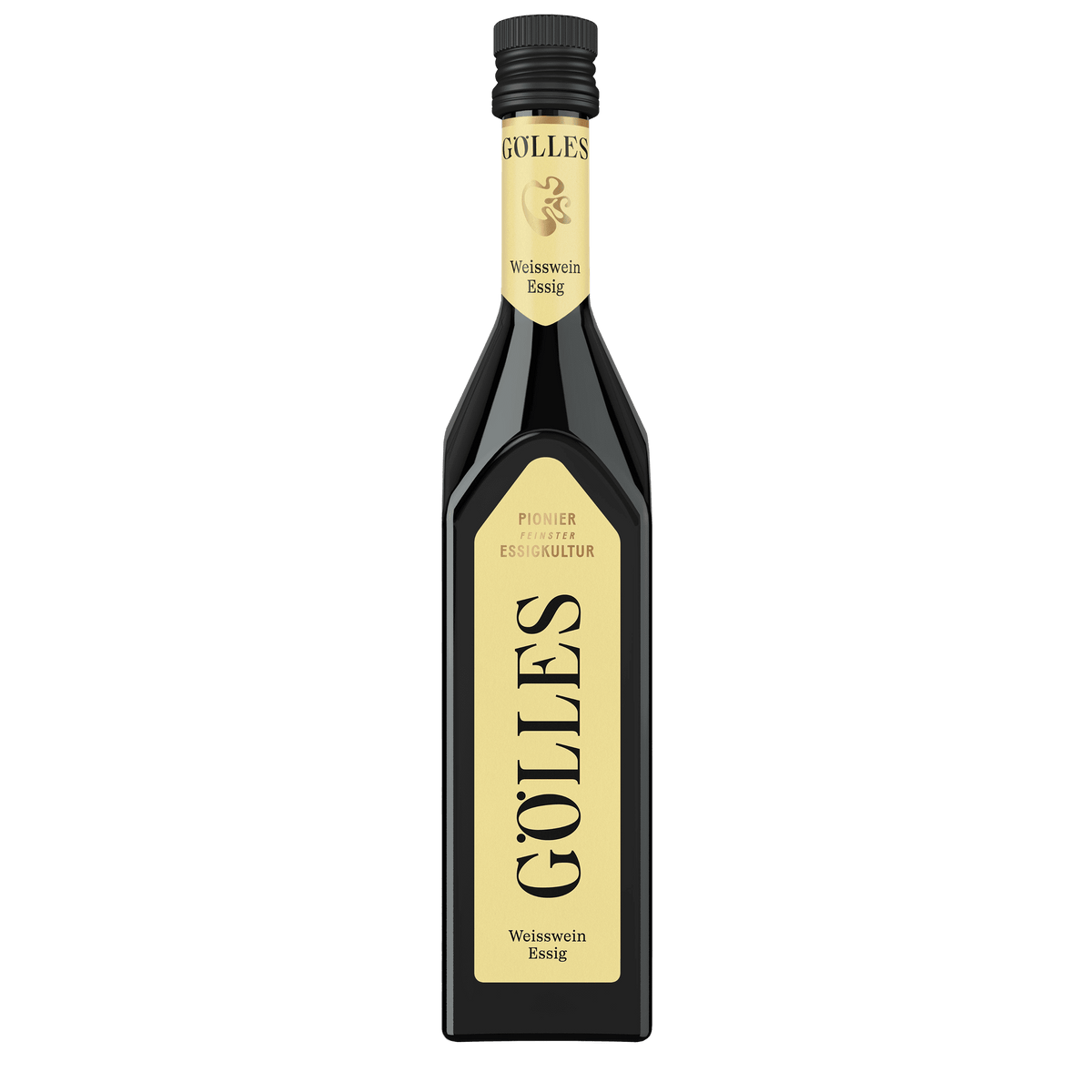
White wine vinegar
Clear white wine vinegar, aged 2 years in oak barrels
Couldn't load pickup availability
- Excellent Ratings
From 250,000 happy customers - Fast Customer Service
by phone, email, or chat - Family-owned since 2002.
ginusslande.com: where good taste lives.
Shipping & Delivery
Your order will reach you in just 1–2 days for as little as €5.45 with DHL, DPD, or UPS. Shipping is free for orders over €99. Need it faster? Choose from our express shipping options.

Payment and Installment Plan
Your payment information is always processed securely. Choose from many payment methods such as PayPal, Klarna, Apple Pay, Mastercard or Visa and benefit from purchase on account and payment by installments. You can find more information in our Payment Terms.
White Wine Vinegar. Clear acidity, two years in oak, the standard for salads.
White Wine Vinegar from Riegersburg: light, clear, and made from white grapes, with 6 percent acidity and aged for at least two years in oak. No fruit vinegar, no sweet balsamic vinegar, no vinegar with added flavorings.
White Wine Vinegar is a classic wine vinegar from the Gölles family, made from white grapes and aged in wood for a long time before bottling. Compared to apple cider vinegar, it deliberately lacks fruit sweetness. Compared to a white wine vinegar from the supermarket, it lacks the biting sharpness. What remains is a clear, pure acidity that brings a salad to life without overpowering it.
Fungi, light, and straightforward in flavor
The white wine vinegar tastes light and clear, with a mild acidity of 6 percent that leans toward fruit. Gölles describes the aroma as evoking a deep wine cellar, mushrooms, and porcini. Beneath that come honeydew melon and a hint of Hokkaido pumpkin.
On the palate, it is pure and straightforward. The two years in the barrel have rounded off the acidity, so that it supports rather than burns. Wood aromas hardly emerge, and the vinegar remains light in color.
Anyone looking for a vinegar that rounds out a dressing through sweetness alone will find it too austere. For this purpose, the sweet-tart light balsamic vinegar is better suited. It is also not intended for drizzling over cheese or desserts.
Cabbage salad, sausage salad, and everything for pickling
White wine vinegar is the all-purpose vinegar for leaf salads, cabbage salad, cucumber salad, sausage salad, and French dressing. With 6 percent acidity, use it sparingly in leaf salads at first and taste as you go. Cabbage salad can take more, because finely sliced cabbage only becomes tender and juicy with plenty of acidity.
A sausage salad with Vienna sausage, red onions, and chives gets a marinade of three tablespoons of vinegar, two tablespoons of rapeseed oil, salt, and pepper. Vienna sausage is a fine boiled sausage from Austria, similar to Lyon sausage. Mix a French dressing from one part vinegar, three parts oil, and one teaspoon of mustard.
From experience: It is the right choice for pickling zucchini, peppers, or pearl onions. Clear acidity without fruit sweetness does not distort the aroma of the vegetables. It harmonizes well with pumpkin seed oil, poppyseed oil, and white grapeseed oil.
From wine to vinegar, then two years of patience
It begins with wine, or alcohol, which the vinegar bacteria convert into acetic acid. In the past, people spoke of the mother of vinegar, a gelatinous layer of these bacteria. Technically, they are bacteria of the genus Acetobacter, which only work with sufficient air. They need warmth and plenty of oxygen; neither sulfites nor flavorings are added.
Then comes the step that takes time: at least two years in an oak barrel. During this time, the barrel is blocked, an investment that cannot be cut short. Vinegar bottled earlier would be sharper in flavor and less versatile.
In older documents, Gölles lists Grüner Veltliner, Austria's most widely grown white grape variety, as the base. On the current product page, it generally refers to white grapes. If some cloudiness settles at the bottom of the bottle over time, that is normal for this natural vinegar.
A classic of Austrian cuisine
What sets white wine vinegar apart is its unpretentiousness: It is the standard by which other vinegars are measured. In Austria, a light wine vinegar has been part of cucumber salad, cabbage salad, and beef marinade for decades. This bottle fulfills exactly this role, only with more composure in its acidity.
The salad becomes Styrian when a few spoonfuls of pumpkin seed oil are added instead of rapeseed oil. The dark oil and the light acidity then create the typical picture on the plate, glossy and bold in flavor.
The 500-ml bottle is intended for daily use, close at hand next to oil and salt. Anyone looking for a bold vinegar for stews in addition to the light one should complement it with the barrel-aged vinegar from red grapes.
A wine vinegar without frills, used every day, and therefore it must be good.
Gölles
Gölles
Nutritional Information
Nutritional Information
Alcohol content
Alcohol content
Ingredients
Ingredients
Distributor
Distributor
Legal guarantee
Legal guarantee

How it all began
Does this sound familiar? You return from vacation with a bottle of olive oil from Portugal in your suitcase, a jar of fruit spread from South Tyrol, perhaps a bar of chocolate from a small factory in France — and you ask yourself: Why can't I find something like this easily at home? We kept asking ourselves this question.
We are Kerstin and Stephan Uhlenbusch from Nordhorn, a city on the German-Dutch border. On our travels through Europe, we made the most wonderful culinary discoveries: mountain apple juices from the high altitudes of South Tyrol, Breton barrel butter, handmade pasta from Italy, French sea salt. It wasn't the big luxury products that fascinated us, but rather the honest, artisan-made foods from people who put their heart and soul into their products.
In 2002, we decided to turn this passion into our profession: to make good food accessible to everyone who cannot travel to the producers themselves. This is how our gourmet shipping business came into being — initially as a store in Nordhorn, soon after as one of the first gourmet online shops in Germany. Back then under the name nur Gutes (only good things) — today we continue it as ginusslande.com. The ambition has remained the same: this is where good taste resides.
Who we are
What drives us is the same curiosity with which we started in 2002: finding out who truly makes good food. Over more than two decades, we have built a network — with producers, traders, restaurateurs, and culinary artisans from all over Europe.
Kerstin was the managing director of the association of leading delicatessen merchants in Germany — the industry association of the country's best owner-managed delicatessen stores. In this role, she not only accompanied but actively shaped the German delicatessen industry. With the deli Festival, we also launched our own B2B trade fair for delicacies, which brought together producers, traders, and restaurateurs from all over Europe. The festival no longer exists today — but the relationships that arose from it still accompany us.
What does this mean for you? We know our industry like almost no one else. Chambers of commerce and economic development agencies from all over Europe repeatedly introduce us to exciting producers who want to offer their products on the German market. This way, genussland always offers something you won't find in any supermarket and hardly in any other shop.
What you'll find here
Our assortment includes fine foods, delicacies, wines, non-alcoholic beverages, and selected kitchen and home accessories — from manufacturers in Germany, Austria, Italy, France, Portugal, Spain, England, Iceland, Denmark, Sweden, Greece, and the USA.
An extra virgin olive oil from Portugal, a genuine Aceto Balsamico from Modena, Fleur de Sel from the Breton coast, hand-mixed spice blends. Fruit spreads, aromatic honey, truffle delicacies, chutneys, and mustard sauces. Vintage sardines and fine canned fish, risotto rice, and handmade pasta — basic ingredients for honest cooking and specialties for special moments.
Our fresh delivery service brings the legendary Beurre Bordier from Brittany, Italian Burrata, and fine salami to your home — securely packaged and continuously chilled.
Wine is particularly close to our hearts: white wine from Rheinhessen and the Pfalz, red wine from Austria and Burgenland, rosé for barbecue season, natural wine for the adventurous, sparkling wine and champagne for special moments. Not from all over the world — but from winemakers we have personally visited and whose work we appreciate. Many of them work organically or biodynamically.
Our Philosophy
What makes a product a genussland product? We ask ourselves this question for every single item we add to our range. The answer is never one-dimensional – it's the combination of craftsmanship, origin, ingredients, and the people behind them.
We ask many questions before a product finds its way into our shop. How is it made? Where do the raw materials come from? What philosophy does the manufacturer pursue? We quickly notice whether we are hearing marketing clichés or if a producer is happy to explain their journey. It is precisely this enthusiasm that we seek – and repeatedly find.
Craftsmanship. We prefer products from small manufactories and family businesses that often produce their culinary treasures by hand for generations. The careful processing and artisanal skill can be tasted in every bite.
Best Ingredients. For us, good quality begins with the raw materials. Whether it's fruit, vegetables, milk, meat, or grain – we ensure that our manufacturers rely on first-class, as natural as possible, ingredients. Many of our producers are organically certified; our shop itself is organically controlled under the number DE-ÖKO-037.
Origin and Regionality. We appreciate products with a clear regional identity. A South Tyrolean mountain apple juice made from slowly ripened, old apple varieties. A Portuguese olive oil from trees that have shaped the landscape for centuries. These stories of origin make delicacies what they are.
Personal relationship with the manufacturer. We have known many of our suppliers personally for years, some for over two decades. We visit them, taste together, and exchange ideas. This proximity guarantees transparency and trust.
At the end of the day, it has to taste good. We try all products ourselves – not just once, but again and again while cooking, at the table, on the plate. Only what convinces us personally finds its way into the shop.
The people behind the products
What brings us the most joy: We get to accompany passionate individuals on their journey. People whose drive it is to make a good product even better. Some have been with us since our founding - for over twenty years.
There's the South Tyrolean fruit farmer who presses mountain apple juice from old, slowly ripened apple varieties, unlike anything else. The Italian balsamic family who ages their vinegar in Modena for decades. The Breton butter manufactory whose hand-churned butter is on the menu of the best restaurants in Europe. The Danish licorice pioneer who reinvented a centuries-old specialty.
Behind every product in our shop stands a person, a family, a story. And it is precisely these stories that make the difference between an interchangeable food item and a true delicacy.
This is where good taste resides
Whether you want to order fine foods online, are looking for a special wine, want to put together a gift for a loved one, or simply want to enrich your kitchen with high-quality ingredients — genussland is the right place for you.
Browse through our assortment, get inspired, and conveniently order your favorite products to your home. Read more about our approach on the Sustainability and Responsibility page. Do you have a question? We look forward to your message to our Customer Service.
Welcome to genussland.
Kerstin and Stephan Uhlenbusch

-
 NewVendor:Gölles
Tomato Vinegar – 500 ml
Tomatenessig im Halbliter für Salatsommer, Buffet und Gastronomie
5 in stockRegular price 14,20€Sale price 14,20€ Regular priceUnit price per -
 NewVendor:Gölles
Pear Brandy Clean Pear
Spicy pear brandy made from the Saubirne, the Williams' successor
Only 3 leftRegular price 47,90€Sale price 47,90€ Regular priceUnit price per -
 NewVendor:Gölles
Pear Brandy Hirschbirne
Tart pear brandy made from an old Styrian cider pear, with character
Only 3 leftRegular price 27,50€Sale price 27,50€ Regular priceUnit price per -
 NewVendor:Gölles
Premium bitter – 350 ml
Walnut bitters made from green St. John's nuts, chilled after meals
Only 3 leftRegular price 25,90€Sale price 25,90€ Regular priceUnit price per -
 Sold outVendor:Gölles
Extra Bitter – 700 ml
Herber Walnussbitter in the large bottle for hosts and festive meals
Regular price 43,90€Sale price 43,90€ Regular priceUnit price per -
 NewVendor:Gölles
Williams Pear Brandy – 350 ml
Clear Williams pear brandy without barrel aging, ideal for sampling
Only 3 leftRegular price 44,50€Sale price 44,50€ Regular priceUnit price per -
 Sold outVendor:Gölles
Williams Pear Brandy – 700 ml
Williams Pear Brandy, Water-Clear, Large Bottle for the Home Bar
Regular price 79,90€Sale price 79,90€ Regular priceUnit price per -
 NewVendor:Gölles
Alte Zwetschke Zwetschkenbrand – 350 ml
Fassgereifter Zwetschkenbrand, acht Jahre Eiche, zum Espresso
Only 3 leftRegular price 44,50€Sale price 44,50€ Regular priceUnit price per -
 Sold outVendor:Gölles
Alte Zwetschke Zwetschkenbrand – 700 ml
Amber-colored Zwetschkenbrand from the oak barrel for long evenings
Regular price 79,90€Sale price 79,90€ Regular priceUnit price per -
 Sold outVendor:Gölles
Apricot Liqueur – 50 ml
Marillenlikör als Miniatur, für zwei Aperitifs oder als Mitbringsel
Regular price 8,00€Sale price 8,00€ Regular priceUnit price per -
 NewVendor:Gölles
Apricot Liqueur – 350 ml
Angesetzter Marillenlikör mit eigenem Brand, mit Sekt als Aperitif
6 in stockRegular price 25,90€Sale price 25,90€ Regular priceUnit price per -
 NewVendor:Gölles
Apricot Brandy – 350 ml
Klarer Marillenbrand aus drei Sorten, die Frucht wie vom Baum
Only 3 leftRegular price 53,90€Sale price 53,90€ Regular priceUnit price per -
 Sold outVendor:Gölles
Apricot Brandy – 700 ml
Dry, fruit-forward apricot brandy for the home bar and kitchen
Regular price 97,90€Sale price 97,90€ Regular priceUnit price per -
 NewVendor:Gölles
Lemon Balsamic Vinegar – 250 ml
Mild lemon seasoning made from lemon juice and balsamic vinegar to try
6 in stockRegular price 10,90€Sale price 10,90€ Regular priceUnit price per -
 NewVendor:Gölles
Lemon Balsamic Vinegar – 500 ml
Zitronenwürze mit Balsamweinessig als Vorrat für Küche und Gastronomie
12 in stockRegular price 14,20€Sale price 14,20€ Regular priceUnit price per -
 NewVendor:Gölles
Pear Vinegar
Tart sloe fruit vinegar for bitter salads and cheese
5 in stockRegular price 7,40€Sale price 7,40€ Regular priceUnit price per -
 NewVendor:Gölles
Plum Vinegar
Hauszwetschken fruit vinegar for red cabbage, game and dark sauces
Only 4 leftRegular price 8,60€Sale price 8,60€ Regular priceUnit price per -
 NewVendor:Gölles
Apple Cider Vinegar
Steirischer Apfelessig aus alten Mostäpfeln, 2 Jahre im Eichenfass
6 in stockRegular price 8,20€Sale price 8,20€ Regular priceUnit price per -
 NewVendor:Gölles
Tomato Vinegar – 250 ml
Fruit vinegar made from Styrian tomatoes for salad, burrata and sugo
6 in stockRegular price 10,90€Sale price 10,90€ Regular priceUnit price per -
 NewVendor:Gölles
Pear Balsamic Vinegar
Milder Birnenbalsam aus alten Mostbirnen, 4 Jahre im Eichenfass
6 in stockRegular price 14,90€Sale price 14,90€ Regular priceUnit price per -
 NewVendor:Gölles
Apricot Vinegar
Sweet and tangy apricot vinegar for curry, stir-fries, and seafood
6 in stockRegular price 8,60€Sale price 8,60€ Regular priceUnit price per -
 NewVendor:Gölles
Raspberry Vinegar – 125 ml Spray Bottle
Fruchtessig aus ganzen Himbeeren im Zerstäuber für Salat und Spargel
6 in stockRegular price 11,40€Sale price 11,40€ Regular priceUnit price per -
 NewVendor:Gölles
Raspberry Vinegar – 250 ml
Fruchtessig aus ganzen Himbeeren für Vinaigrette, Ente und Desserts
6 in stockRegular price 12,80€Sale price 12,80€ Regular priceUnit price per -
 NewVendor:Gölles
Quince Vinegar
Honey-sweet fruit vinegar as a lemon substitute for sauces and fish
6 in stockRegular price 8,60€Sale price 8,60€ Regular priceUnit price per


